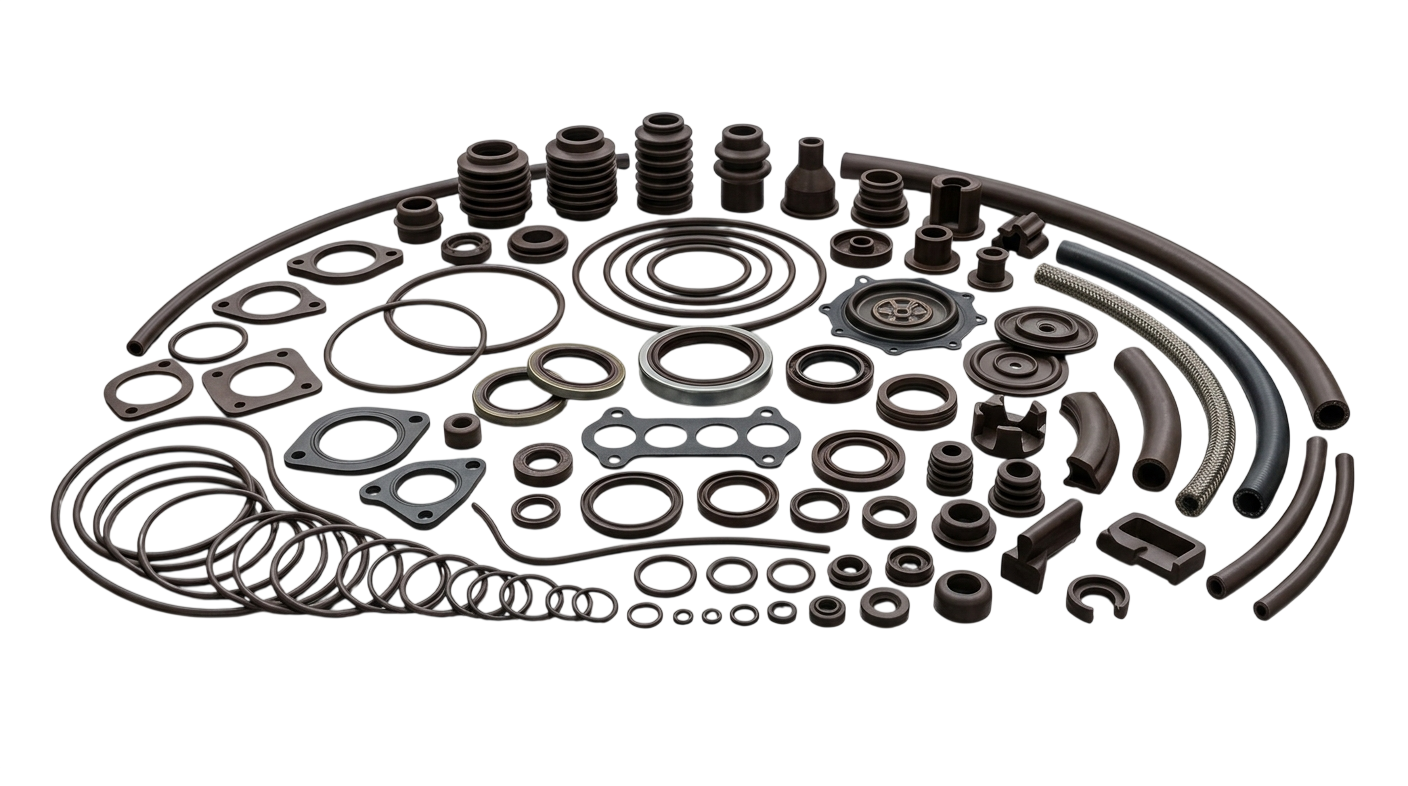
Viton® rubber (FKM) is a high-performance fluoroelastomer widely utilized for critical industrial sealing due to its extreme durability and resistance to harsh environments.
Major Advantages
Exceptional Heat Resistance: Standard grades maintain integrity at continuous temperatures up to 400°F (200°C), with specialty formulations handling short-term spikes up to 600°F (315°C).
Broad Chemical Compatibility: It resists a vast range of corrosive fluids, including oils, fuels, lubricants, mineral acids, and most aliphatic/aromatic hydrocarbons.
Low Compression Set: It retains its original shape and elasticity after prolonged pressure, ensuring a reliable, long-lasting seal even under mechanical stress.
Environmental Stability: Inherently resistant to ozone, UV radiation, oxygen, and extreme weathering, making it suitable for long-term outdoor or exposed use.
Low Gas Permeability: Its dense molecular structure minimizes gas leakage, which is critical for fuel and vacuum systems.
Safety and Standards: Specialized grades meet strict FDA requirements for food and pharmaceutical applications.
Limitations
Cost: Viton is significantly more expensive than common elastomers like Nitrile (NBR) or Neoprene, often making it an investment reserved for high-performance applications.
Low-Temperature Performance: It becomes stiff and brittle at temperatures below -20°C to -30°C (-4°F to -22°F), which can lead to failure in dynamic cold-weather applications.
Chemical Incompatibility: It performs poorly or swells significantly when exposed to ketones (e.g., acetone), amines, esters, ethers, and strong polar solvents.
Tear Resistance: While strong, it generally has lower tear resistance at high temperatures compared to materials like silicone rubber.
Toxic Byproducts: If exposed to extreme fire or heat, it can decompose and release hydrogen fluoride, a highly toxic gas.